
The Hidden Costs of Food Packaging Margin Pressures: Strategies for Survival

Food packaging margin pressures are no longer a temporary challenge in the U.S. market—they are a structural reality. While most food and beverage companies focus on ingredient inflation or labor shortages, packaging has quietly become one of the fastest-growing threats to profitability.
What makes packaging margin pressures especially dangerous is that many of the costs are hidden, fragmented across production, logistics, sustainability compliance, and supply chain inefficiencies. This article breaks down those hidden costs and outlines practical, data-driven strategies to protect margins without sacrificing quality or compliance.
Understanding Margin Pressures in Food Packaging
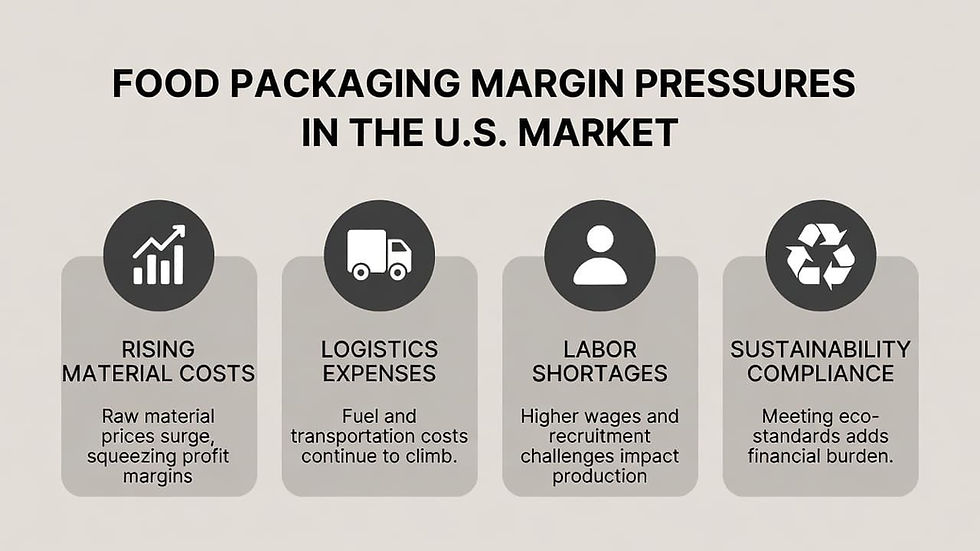
What Are Food Packaging Margin Pressures?
Food packaging margin pressures refer to the shrinking profit margins caused by rising packaging-related costs that cannot be fully passed on to customers. These pressures affect manufacturers, co-packers, restaurants, and private-label brands alike.
Unlike ingredients, packaging costs are often locked into long-term contracts, minimum order quantities, and equipment compatibility—making them harder to adjust quickly.
Why Packaging Has Become a Margin Battleground in the U.S.
Inflationary pressure with limited pricing power
Growing demand for eco-friendly packaging
Stricter food safety and labeling regulations
Higher logistics costs tied to fuel and labor
Packaging sits at the intersection of all four.
Factors Contributing to Rising Packaging Costs

Paper, aluminum, molded fiber, and bioplastics have all experienced price volatility driven by tariffs, energy costs, and global supply disruptions. Unlike ingredients, packaging materials often have fewer substitute options due to performance and compliance requirements.
Labor, Energy, and Compliance Costs
Packaging costs are not limited to materials:
Energy-intensive forming and converting processes
Labor shortages increasing per-unit conversion costs
FDA, USDA, and state-level compliance adding indirect expenses
These costs are often absorbed silently into packaging quotes.
The Overlooked Cost: Packaging Design and SKU Complexity
One of the most ignored margin killers is over-engineered packaging design.
📊 Hidden Cost Breakdown
Cost Type | Visible to Finance | Impact on Margin |
Material price | ✅ Yes | Medium |
Tooling & molds | ❌ Often missed | High |
Changeover time | ❌ | High |
Excess SKUs | ❌ | Very High |
Damage & returns | ❌ | High |
Reducing SKU variety by even 10–15% can unlock meaningful margin improvements without touching unit price.
The Impact on Production Efficiency
How Inefficient Packaging Slows Down Production
Packaging that looks inexpensive on paper may reduce line speed, increase rejects, or require frequent machine adjustments. These inefficiencies rarely appear on packaging invoices—but they erode margins daily.
Strategies to Improve Production Efficiency Without CapEx
Instead of investing in new equipment, companies can:
Standardize container footprints
Use packaging compatible with multiple lines
Optimize material thickness for machine stability
📊 Production Efficiency Comparison
Metric | Inefficient Packaging | Optimized Packaging |
Line speed | Low | High |
Changeovers/day | 4–6 | 1–2 |
Scrap rate | 5–8% | <2% |
Labor per unit | High | Lower |
Logistics Optimization for Cost Reduction

Why Packaging Decisions Drive Logistics Costs
Packaging determines:
Pallet density
Truck cube utilization
Shipping weight
Damage rates
A small dimensional change can reduce transportation costs by double digits annually.
Practical Logistics Optimization Techniques
Switch from air-heavy to stackable designs
Reduce headspace in containers
Use lighter materials with equal strength
📊 Logistics Cost Impact Example
Factor | Before Optimization | After Optimization |
Units per pallet | 720 | 960 |
Truckloads/month | 42 | 31 |
Annual freight cost | $1.26M | $0.93M |
The Role of Eco-Friendly Packaging in Margin Protection
Why Sustainable Packaging Is Not Always More Expensive
The mistake many companies make is focusing only on unit price, not total cost of ownership (TCO).
Eco-friendly packaging can reduce:
Waste disposal fees
Damage rates
Brand risk and regulatory exposure
Innovations Making Eco-Friendly Packaging Economically Viable
Molded fiber replacing plastic clamshells
Lightweight PLA-lined paper replacing multilayer plastics
Mono-material designs improving recycling economics
Sustainability and margin protection are no longer mutually exclusive.
Navigating Supply Chain Challenges
Supplier Concentration and Risk Exposure
Relying on a single packaging supplier increases vulnerability to shortages, MOQs, and price shocks.
Building a More Resilient Packaging Supply Chain
Effective strategies include:
Dual sourcing for core SKUs
Regional suppliers to reduce freight volatility
Demand forecasting tied to packaging consumption, not sales alone
Conclusion: Building a Sustainable Future Under Margin Pressure
Key Takeaways
Food packaging margin pressures are driven by hidden, systemic costs
Packaging design and logistics decisions impact margins more than unit price
Production efficiency and sustainability can protect margins simultaneously
Call to Action
If margin pressures are squeezing your business, start with packaging. A packaging audit focused on efficiency, logistics, and design simplification often delivers faster ROI than price increases or cost-cutting elsewhere.
FAQ
Q1: What causes food packaging margin pressures the most?
A: Hidden costs such as inefficiency, logistics waste, and SKU complexity often have a larger impact than material price increases.
Q2: Is eco-friendly packaging always more expensive?
A: Not when evaluated on total cost of ownership rather than unit price alone.
Q3: How can small brands manage packaging margin pressures?
A: By standardizing packaging, reducing SKUs, and working with suppliers that offer scalable solutions.
Q4: Can packaging changes really improve margins without raising prices?
A: Yes. Production efficiency and logistics optimization often unlock margin improvements without price increases.

Email: abel@mana-eco.com
WhatsApp: +86 13867471335
We specialize in a full range of disposable tableware. With fully automated production lines and certifications like FDA, BPI, and OK Compost, we offer high-quality, eco-friendly tableware made from biodegradable materials such as sugarcane bagasse and PLA, committed to providing customers with more sustainable and environmentally friendly options.


Comments