
Disposable Cutlery for Europe vs. the United States (2026):A Practical Buyer’s Guide to Materials, Compliance, and Real-World Performance


When global buyers source disposable cutlery, the most common assumption is that forks, spoons, and knives can be standardized across markets. In practice, this assumption is one of the fastest ways to create customer complaints, SKU failures, and unstable reorder cycles.
Europe and the United States operate under very different rules—not only regulatory rules, but usage expectations, buyer risk tolerance, and sustainability logic. A cutlery product that performs well in a European catering program may fail quickly in a U.S. foodservice distribution channel, even if it is technically “compliant” in both markets.
This guide is written for importers, distributors, and foodservice buyers who want to build market-fit disposable cutlery programs in 2026—not just compliant products, but SKUs that survive real-world use.
Why “One Cutlery SKU” Rarely Works in Both EU and U.S. Markets
The core difference between Europe and the U.S. is philosophical.
European buyers tend to approach disposable cutlery through the lens of environmental systems: material origin, waste pathways, and claim accuracy. (EU single-use product policy) Sustainability is not just a brand story—it is a regulatory and reputational risk factor.
The U.S. market, by contrast, is more performance- and cost-driven. Importers and distributors focus on landed cost, supply stability, and customer satisfaction at scale. A cutlery SKU that bends, snaps, or feels “cheap” can trigger negative reviews and rapid delisting, regardless of its environmental credentials.
Both markets care about sustainability—but they measure failure differently.
What Buyers Actually Struggle With (Beyond Certifications)
Most supplier conversations revolve around certifications. Most buyer complaints do not.
In real foodservice environments, disposable cutlery is stressed by:
heat (hot entrees, soups)
oil and moisture
dense proteins (meat, plant-based alternatives)
time (how long the cutlery stays in contact with food)
Forks and spoons usually perform acceptably across materials. Knives are where programs break.
A knife that cannot cut the hardest menu item becomes a customer-facing failure almost immediately—especially in the U.S. market.
Material Selection Revisited: A Usage-Driven
Comparison

Choosing the right cutlery material is less about labels and more about matching material behavior to food type, service duration, and customer expectations.
CPLA Cutlery: Plastic-Like Performance When Designed Correctly
CPLA (Crystallized PLA) remains one of the most widely used materials across both markets because it offers:
strong heat resistance compared with standard PLA
a familiar, plastic-like hand feel
good stiffness when thickness is properly controlled
In Europe, CPLA is commonly used in catering, airline service, and premium takeaway where buyers want a biopolymer alternative to petroleum plastic.
In the United States, CPLA is often treated as the baseline “professional grade” eco cutlery, especially for hot meals and institutional foodservice. However, U.S. buyers are highly sensitive to thickness and rigidity—thin CPLA SKUs that pass lab specs may still fail in customer use.
Sugarcane Bagasse Cutlery: Where Sustainability Meets Foodservice Reality

Sugarcane bagasse cutlery occupies a different role from CPLA, wood, or starch blends.It is not designed to imitate plastic, nor is it simply a “plastic-free visual alternative.”
Bagasse cutlery is made from the fibrous residue left after sugarcane juice extraction—a true by-product material, which gives it strong circular-economy credibility. For many buyers, this matters more than whether a product feels like plastic.
From a functional perspective, high-quality bagasse cutlery offers several advantages:
Good heat resistance for hot meals such as rice dishes, pasta, and cooked proteins
Neutral taste and odor, especially important for soups and starch-heavy foods
Higher rigidity than thin biopolymer cutlery, reducing bending complaints in forks and spoons
Short-duration liquid stability when properly molded and cured
Bagasse cutlery performs particularly well in full-meal foodservice scenarios, especially when paired with bagasse bowls, plates, and clamshells. Many buyers prefer material consistency across the entire meal set, rather than mixing fiber containers with polymer cutlery.
Its limitations should also be understood:
Knife performance is moderate and best suited to soft proteins and vegetables
Not designed for extended soaking in liquids
Natural fiber texture may appear less “premium” to some U.S. mass-market programs
EU vs. U.S. Market Fit
In Europe, bagasse cutlery is often viewed as a system-compatible solution that avoids the bioplastic debate entirely. It aligns well with fiber-based waste streams and compostable packaging programs.
In the United States, adoption is growing fastest in campus dining, corporate cafeterias, event catering, and brands already using bagasse food containers. In these channels, the value is material coherence and reduced customer confusion, not just sustainability messaging.
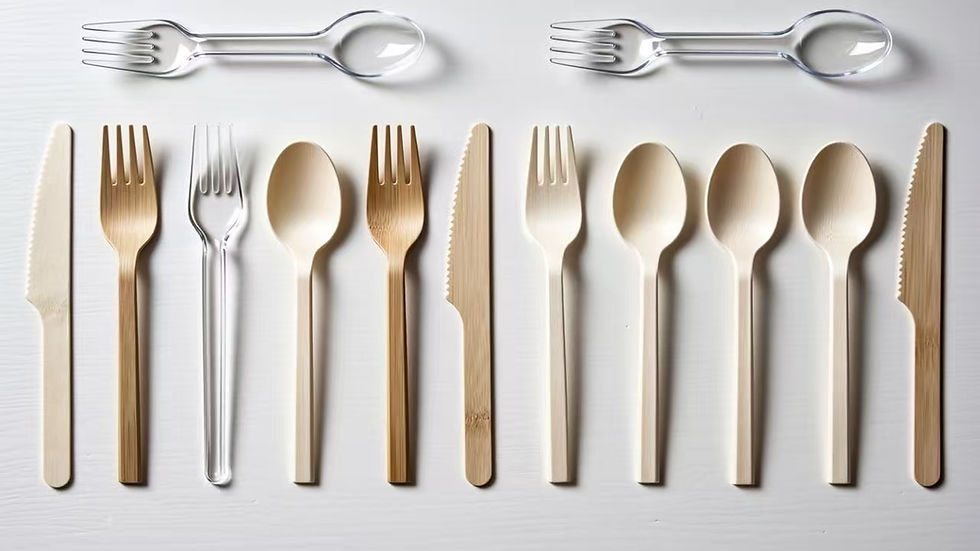
Wooden Cutlery: Strong Visual Signal, Mixed Functional Results
Wooden cutlery is widely associated with “plastic-free” positioning, especially in Europe. It performs well in:
cold or room-temperature foods
short-duration use
eco cafés and event catering
However, wooden cutlery can struggle with:
soups and wet foods
dense proteins (especially knives)
inconsistent surface finish and taste perception
Many professional buyers now adopt hybrid solutions, such as wooden forks and spoons combined with CPLA or bagasse knives.
Starch-Based Blends: Cost Control With Clear Boundaries
Starch-based cutlery blends are most common in the U.S. value segment. They can be cost-competitive and suitable for cold or light foods, but performance varies significantly by formulation.
Buyers should clearly define:
acceptable heat exposure
flex tolerance
complaint thresholds
These materials work best as channel-specific solutions, not universal SKUs.
Material Performance Snapshot (Buyer-Oriented)
Material | Hot Foods | Dense Protein | Soup / Liquid | EU Acceptance | U.S. Acceptance |
CPLA (thick) | Excellent | Good | Excellent | High | Very High |
Bagasse (Sugarcane) | Good–Excellent | Medium | Good (short use) | Very High | High |
Wooden Fork | Medium | Medium | Poor | High | Medium |
Wooden Knife | Low | Poor | Very Poor | Medium | Low |
Starch Blend | Medium | Low | Medium | Medium | Medium |
Design Differences That Trigger Buyer Complaints
Design expectations differ sharply:
U.S. buyers favor longer, thicker, heavier cutlery that feels close to traditional plastic
EU buyers are more accepting of compact, lighter designs when sustainability and packaging efficiency are clear
A fork that feels “eco-lightweight” in Europe may feel “cheap” in the U.S.
Packaging Strategy: The Hidden Cost Driver

Packaging affects labor, storage, and damage rates.
Packaging Type | EU Preference | U.S. Preference | Operational Impact |
Bulk loose | High | Medium | Lowest unit cost |
Paper band | High | Low | Better waste optics |
Cutlery kits | Medium | Very High | Faster warehouse handling |
U.S. distributors often accept higher unit prices if packaging reduces picking time and errors.
Compliance Is Not the Same as Market Acceptance
Compliance enables entry. Performance enables survival.
European buyers focus on claim accuracy and environmental alignment(industrial composting conditions).U.S. buyers focus on operational clarity, broker readiness, and customer satisfaction.
Successful suppliers prepare for both.
How Professional Buyers Reduce Risk
Experienced buyers rarely rely on a single material. Instead, they build:
Value tier (starch-based or entry eco)
Mainstream tier (CPLA or bagasse)
Premium tier (wood or hybrid systems)
This approach stabilizes programs across price changes and regulatory shifts.
Where ManaPacking Fits
ManaPacking supports buyers building long-term disposable cutlery programs through:
sugarcane bagasse cutlery as a system-level solution
complementary CPLA and wooden options
consistent specifications and mold control
flexible bulk and custom packaging formats
For professional buyers, consistency matters more than novelty.
Final Takeaway
Europe and the United States do not reject the same cutlery for the same reasons.
Winning programs are built by matching:
material behavior
food type
customer expectation
and distribution reality
Design for how food is eaten, not just how products are regulated.
FAQ – Disposable Cutlery for EU & U.S. Buyers (2026)
Q: Can one disposable cutlery program serve both markets?
Yes, but only as a tiered portfolio—not a single universal SKU.
Q: Is sugarcane bagasse cutlery suitable for hot meals?
Yes, when properly molded, it performs well for hot foods and short-duration liquid contact.
Q: Does “compostable” affect import duty?
No. Duties are determined by material composition and HS classification, not environmental claims.

Email: abel@mana-eco.com
WhatsApp: +86 13867471335
We specialize in a full range of disposable tableware. With fully automated production lines and certifications like FDA, BPI, and OK Compost, we offer high-quality, eco-friendly tableware made from biodegradable materials such as sugarcane bagasse and PLA, committed to providing customers with more sustainable and environmentally friendly options.
Comments