
Unveiling the Truth: Are Plastic Forks Recyclable?

Updated: Oct 24, 2025
In the United States, millions of single-use plastic forks are used every day. They are used in cafeterias, for take-out meals, at food trucks, and at events.
But when we talk about recycling them, we often ask: Are plastic forks recyclable? The short answer is sometimes. But they are not recycled reliably and not in most curbside programs.
In this article we will explain what plastic forks are made of. We will explain why they are hard to recycle.
We will look at what real alternatives exist. And we will tell you how you should throw them away.

Understanding Plastic Forks
What are plastic forks made of?
Plastic forks are typically manufactured from polymer resins – often commodity plastics derived from fossil fuels.The most common types are polystyrene (PS), polypropylene (PP) or sometimes polyethylene (PE) blends.
Because the utensil must be rigid, relatively inexpensive and moldable, manufacturers often choose single-use profiles rather than designing for recyclability.
A key detail: many single-use forks are made from #6 polystyrene (PS), which is lightweight, cheap, but very poor in recyclability. Some higher-end versions may show “#5 polypropylene (PP)” and even recycled content, but these are rare in the typical foodservice environment.
Types of plastics commonly used
Understanding the “plastic code” helps. Plastics bear a resin-identification code (RIC) within the recycling triangle. In general:

“Because there are so many different types of plastic… the sorting process is labor-intensive… it’s difficult to see how a circular economy can be met.”
For plastic forks, the downside is many are small, light, made of PS or mixed plastics – complicating sorting and processing.
Recycling Challenges
Are plastic forks recyclable?
In theory, yes – any plastic material could be recycled if collected clean, sorted, processed and remade.
But in practice: most plastic forks go to landfill or incineration in the U.S. There are a few pilot programs or drop-off streams that accept them, but not standard curbside.
One niche report notes: “Most single-use plastic cutlery … falls through gaps in the machinery” at recycling plants.
Why?
Because their shape, material and scale pose serious barriers.
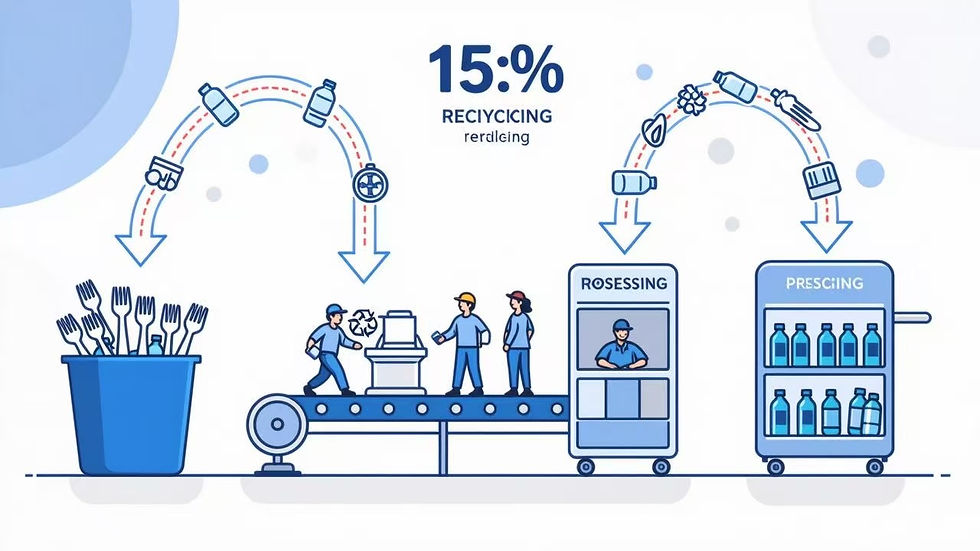
Here’s how the typical recycling stream works:
Consumer puts items in bin → Materials Recovery Facility (MRF) collects.
Items are sorted by type, color, size; cleaned of food residue.
Sorted plastics are baled and sold to re-processors, melted into pellets, then turned into new products (often lower grade).But for plastic utensils:
Small size means they may slip through equipment, get lost or end up as contaminants.
Contamination (food residue, grease) lowers material value and can cause whole batches to be rejected.
Mixed resin or unknown codes make it cost-ineffective to separate them. Mechanical recycling degrades plastic polymers so they often can’t become high-quality products. PMC+1For these reasons, even when a fork is technically made of a recyclable resin (#5 PP or #2 HDPE), the practical likelihood of it being recycled via your local curbside program is very low.
Why recycling isn’t a one-size-fits-all solution
Even if you clean the fork and try to recycle it, your local system may not accept it. A 2023 review of the U.S. recycling system found only 32.1 % of waste is recycled or composted — and major “leaks” occur when materials are unaccepted, contaminated or sorted out.
In addition:
Some single-use plastics are labeled “recyclable” but in practice are not collected or re-made into new items because markets for the recycled material don’t exist.
“Wish-cycling” (putting items in recycling hoping they’ll be recycled) can actually harm the system by increasing contamination. Thus, when it comes to plastic forks: even if you mean well, you may inadvertently cause sorting inefficiencies or contamination.
Alternatives to Plastic Utensils
Recyclable utensils you can use
You should not use standard plastic forks. You can choose better alternatives. These options are more sustainable and are actually recyclable.
Consider recycled plastic utensils made of #5 PP. They must be clearly labeled. But you should check with your local recycling program first.
Another option is compostable cutlery. This is made from plant-based materials or wood fibers.
You can also use reusable options. These are items like stainless steel or strong plastic for long-term use.
One perspective says single-use items are a small part of total plastic waste. But they have a very high cost and environmental impact.s.
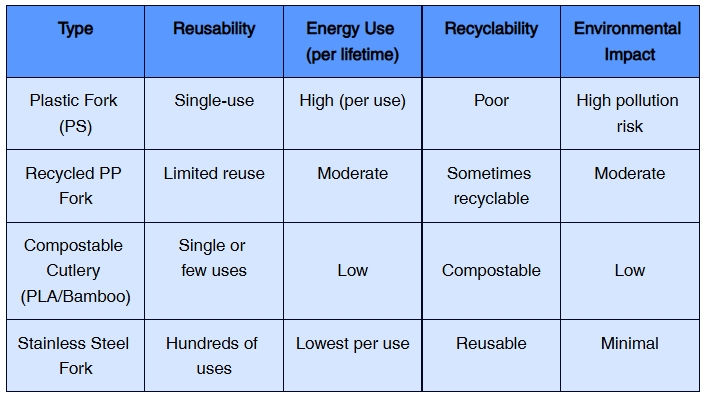
The benefits of switching to reusable options
Resource saving: A stainless-steel fork reused hundreds of times uses far less energy and material per use than 100 single-use plastic forks.
Reduced contamination: Using fewer single-use items avoids the “small items slip through” problem in recycling streams.
Reduced microplastic release: Disposable plastic utensils may degrade over decades or centuries, breaking down into microplastics. New York League of Conservation Voters
Better consumer experience: Many people perceive reusable utensils as higher quality — which may increase uptake of sustainable behaviours.
Best Practices for Disposal
What to do with plastic forks
Check your local recycling rules. Some places do not take plastic forks. They are too small or the wrong type.
Clean the forks before you throw them away. This stops food from making other recycling dirty.
If you are not sure, throw them in the trash. Putting wrong things in recycling can cause problems. It is worse than throwing them away.
Look for drop-off programs. Some special places or food programs might take the forks. They can recycle them.
How to properly dispose of plastic cutlery
Sort at source: If your office or event uses plastic forks, label bins accordingly with clear “trash” vs. “recycle” signage.
Educate users: Encourage requesting utensils only when needed — reducing the volume is half the solution.
Work with vendors: If catering, ask for utensils made of easily recyclable resin (#5 PP) or compostable material.
Track and improve: Keep data on how many utensils used, diverted, or disposed. Use this to improve for next event.

Conclusion
Recap: Are plastic forks and knives recyclable? Technically yes for some types, but practically no in many U.S. curbside systems.
They are small and their plastic type is often unclear. They can be dirty and there is little demand for them.
So, they are largely not recyclable in practice. And because of that, relying on recycling alone is not enough.
Instead, choose sustainable options. You can ask for fewer single-use utensils.
You can also switch to options that are truly recyclable or reusable. And you should dispose of them properly when you must use disposables.
FAQ
Q1: Can I put plastic forks in my curbside recycling bin?
A1: Only if your local program explicitly accepts the type of utensil and resin. Check local guidelines. Most often, plastic forks are not accepted.
Q2: What do the resin identification codes on plastic forks mean?
A2: The code inside the triangle (e.g., #5) identifies the plastic resin used.
Knowing the code helps determine recyclability.
Q3: Are compostable plastic forks truly better?
A3: They can be, if they’re certified compostable and sent to an industrial composting facility. But if they’re thrown into regular trash or recycling mistakenly, they may not decompose properly.
They’re better than non-recyclable plastic, but the infrastructure must support them.
Q4: How can I tell if a plastic fork is recyclable?
A4: Look for the resin code, check with the manufacturer or supplier for plastic grade, verify your local recycling program’s acceptance of that code and item size.
Often there will be a label: “Please recycle” or “Made from #5 PP”.
Q5: Do restaurants have to switch to alternative utensils?
A5: Some states and municipalities impose regulations on single-use plastics or polystyrene food-ware, but regulations differ by area.
Many restaurants are voluntarily switching due to consumer expectation and cost savings on waste.
WhatsApp: +86 13867471335 Email: abel@mana-eco.com


Comments