
Sugarcane Bagasse vs Plastic Food Packaging: Cost, Performance, and Compliance


Plastic food packaging has dominated the global foodservice industry for decades. It is cheap, familiar, and easy to make in large amounts. But now, foodservice brands, distributors, and importers are starting to question if plastic still makes sense. This is because the rules and how businesses work are changing quickly.
Sugarcane bagasse food packaging has become a popular alternative. But the choice to switch is not about feelings or just sustainability. It is more about cost, how it actually works, and the future risk of breaking new rules.
This article gives a practical comparison of sugarcane bagasse and plastic food packaging. It focuses on how each material works in real foodservice operations, not just in theory.
Why Foodservice Brands Are Rethinking Plastic Packaging
Regulatory Pressure Is Increasing
Across major markets, plastic food packaging is facing growing restrictions. For example, there are now single-use plastic bans. There are also taxes on plastic packaging. There are restrictions on plastic-coated paper too. And there are increased reporting requirements for plastic usage.
These changes do not happen overnight, but they create long-term uncertainty for brands. These brands rely heavily on plastic containers.
For importers and distributors, regulatory risk means commercial risk. This can mean delays, rejected shipments, or forced product changes.
Consumer Trust in Plastic Is Declining
Beyond regulations, consumer perception has shifted. Now plastic is increasingly linked to environmental harm. It is also linked to microplastic contamination. And it is linked to poor recyclability.
Even when plastic containers are technically recyclable, real-world recycling rates stay low. This gap has pushed many brands to consider other materials. These materials are easier to explain to customers. They are also easier to dispose of responsibly.
Understanding the Material Difference

Before comparing performance or cost, it is essential to understand how these materials are fundamentally different.
What Sugarcane Bagasse Is and Where It Comes From
Sugarcane bagasse is the fibrous residue left after sugarcane juice extraction. Rather than being produced specifically for packaging, it is a byproduct of an existing agricultural process.
(👉A detailed explanation of what sugarcane bagasse is and how it is produced can be found here)
From a material perspective, bagasse fibers are naturally rigid, heat-resistant, and suitable for molded pulp production—without the need for plastic coatings.
How Plastic Food Containers Are Manufactured
Plastic food packaging is typically made from petroleum-based polymers such as PP or PET. These materials require:
Fossil fuel extraction
Refining and polymerization
Additives for heat resistance and flexibility
While plastic offers consistency, it also depends entirely on non-renewable resources and complex chemical processing.
Cost Comparison: Bagasse vs Plastic Over Time
Unit Price vs Total Cost of Ownership
At first glance, plastic containers often appear cheaper on a per-unit basis. However, unit price alone does not reflect the full cost of packaging.
When evaluating packaging materials, experienced buyers increasingly consider Total Cost of Ownership (TCO), which includes:
Product failure rates
Compliance and certification costs
Brand risk and re-packaging expenses
In many foodservice scenarios, bagasse containers reduce hidden operational costs by offering better performance stability.
Hidden Costs in Plastic Packaging
Plastic packaging can introduce indirect costs such as:
Higher regulatory exposure
Re-labeling or redesign costs due to policy changes
Customer dissatisfaction related to sustainability concerns
These costs rarely appear on invoices, but they affect long-term profitability.
Performance Comparison in Real Foodservice Use

Heat Resistance and Grease Handling
One of the most common misconceptions is that compostable materials cannot handle hot or greasy foods.
In practice, well-manufactured bagasse containers:
Withstand hot meals and steam
Handle oily and saucy foods
Maintain shape under heat
Plastic containers may soften at high temperatures or warp in microwave use, depending on polymer type and thickness.
Transport, Stacking, and Delivery Reliability
For delivery-focused businesses, packaging failure is not an option.
Bagasse packaging performs well in:
Stacking during transport
Maintaining rigidity in clamshell formats
Reducing spills and deformation
These factors directly influence refund rates, customer complaints, and operational efficiency.
Compostability and End-of-Life Outcomes
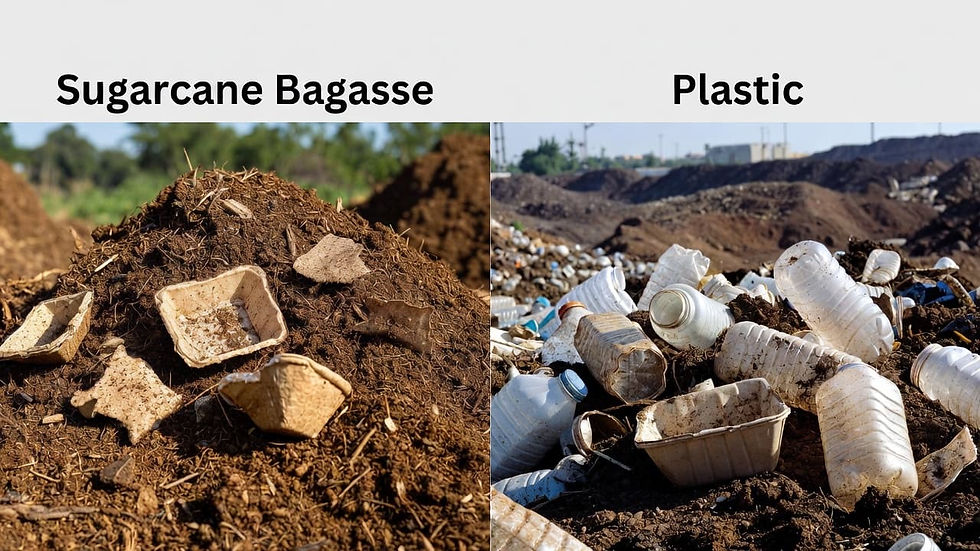
Why Compostable Does Not Equal Biodegradable
The terms “biodegradable” and “compostable” are often confused.
Biodegradable materials may break down slowly and leave residues
Compostable materials break down into non-toxic organic matter within a defined timeframe
High-quality sugarcane bagasse packaging is industrially compostable and often suitable for home composting under the right conditions.
Why Composting Facilities Accept Bagasse but Reject Plastics
Many composting facilities reject biodegradable plastics because they:
Leave microplastic fragments
Do not break down consistently
Contaminate compost streams
Bagasse, being plant fiber–based, aligns more closely with composting infrastructure, making disposal outcomes more predictable.
Compliance and Certification Risks
Plastic Bans and Regional Regulations
Plastic regulations vary by region, but the overall direction is consistent: tighter control and reduced tolerance.
Examples include:
State-level bans in the U.S.
Restrictions on plastic-coated paper in multiple markets
For international trade, these fragmented regulations increase complexity and risk.
How Bagasse Reduces Long-Term Compliance Risk
Sugarcane bagasse packaging aligns more easily with:
Food-contact safety standards
Compostability certifications
Sustainability reporting requirements
This reduces the likelihood of forced material changes or regulatory conflicts in the future.
When Plastic Still Makes Sense
A balanced comparison requires honesty.
Plastic packaging may still be appropriate for:
Long-term liquid storage
Vacuum-sealed applications
Extremely low-cost, non-food-contact uses
The goal is not to eliminate plastic universally, but to use it where it truly performs better—and replace it where it does not.
Which Packaging Is Right for Your Business Type?
Restaurants and Cafés
Bagasse is well-suited for dine-in and takeaway operations that handle hot food and want visible sustainability.
Catering and Airlines
These operations benefit from bagasse’s rigidity, stackability, and compliance with international standards.
Food Delivery Brands
Delivery-focused brands often prioritize packaging that minimizes failure during transport. Bagasse’s structure and heat resistance make it a reliable choice.
FAQ: Bagasse vs Plastic Food Packaging
Is sugarcane bagasse packaging more expensive than plastic?
Per unit, sometimes yes. Over time, operational and compliance costs often offset the difference.
Can bagasse containers replace plastic in all applications?
Not all, but in most hot food and takeaway scenarios, bagasse performs effectively.
Does bagasse packaging contain plastic coatings?
True bagasse products are plastic-free.
Is bagasse accepted by composting facilities globally?
Most industrial composting facilities accept bagasse, though local policies vary.
Is bagasse safe for food contact?
Certified bagasse packaging meets FDA and other food safety standards.
Final Thoughts
The choice between sugarcane bagasse and plastic packaging is not just about cost. It is a strategic choice. This choice is shaped by rules, by how it performs, and by long-term brand plans.
For many food brands, bagasse gives a good balance. Plastic finds it harder to keep this balance. This balance means being reliable, following laws, and being sustainable. And it does this while still working well.
As rules get stricter and what customers want changes, materials that work in real life will keep replacing the ones that do not.

Email: abel@mana-eco.com
WhatsApp: +86 13867471335
We specialize in a full range of disposable tableware. With fully automated production lines and certifications like FDA, BPI, and OK Compost, we offer high-quality, eco-friendly tableware made from biodegradable materials such as sugarcane bagasse and PLA, committed to providing customers with more sustainable and environmentally friendly options.


Comments