
Plastic Alternatives Food Packaging: Why Buyers Are Diversifying Away From Plastic Materials

Plastic Alternatives Food Packaging: Why Buyers Are Diversifying Away From Plastic Materials

In recent years, plastic alternatives food packaging has become an important topic for procurement managers in the foodservice industry.
For a long time, plastic was the main material for disposable food packaging and tableware. Products made from polypropylene, polystyrene, and PET were the most common in the market. This was because they were light, strong, and cheap to make.
In many parts of the foodservice industry, plastic was simply the most useful choice.
But now, the way people buy packaging materials has started to change. In the past few years, a number of new developments have made buyers think again about how they get disposable packaging.
Resin prices are going up. Supply chains have been disrupted. And there is more pressure from rules against single-use plastics. Because of these things, buying strategies are shifting. Buyers are no longer using only plastic. Instead, they are slowly looking at other types of materials.
Plastic Alternatives Food Packaging: Comparing Material Cost Structures

One of the most important drivers behind this shift is the growing unpredictability of plastic resin markets.
Plastic materials are closely tied to petrochemical supply chains, which are influenced by several external factors.
Energy Market Volatility
Most plastic resins originate from petrochemical feedstocks derived from oil and natural gas.
When crude oil prices rise, the cost of producing materials such as polypropylene or polyethylene typically increases as well.
Over the past decade, energy markets have experienced several periods of volatility. These fluctuations can quickly translate into higher costs for manufacturers that rely heavily on plastic materials.
For procurement managers responsible for purchasing large volumes of packaging materials, sudden price increases can disrupt budgeting and long-term supply agreements.
Supply Chain Disruptions
Global logistics has also become less predictable.
Events such as shipping delays, port congestion, and geopolitical tensions have demonstrated how vulnerable global supply chains can be.
Plastic resins are traded internationally, and many countries depend on imported materials. When shipping routes are disrupted or freight costs rise, the total cost of plastic packaging can increase significantly.
Even when the raw material price remains stable, logistics costs can still affect the final price of finished products.
Regulatory Pressure
Another factor influencing procurement decisions is the growing number of regulations targeting single-use plastics.
Many governments have introduced policies aimed at reducing plastic waste. These regulations vary from country to country but often include restrictions on certain disposable plastic products.
Large restaurant chains and foodservice brands are also setting sustainability targets, which frequently involve reducing the use of conventional plastics.
For packaging buyers, this means that procurement decisions are increasingly influenced by environmental considerations in addition to cost.
Comparing Material Cost Structures
To understand why companies are exploring alternative materials, it is helpful to compare the cost structures of different packaging materials.
While exact figures vary depending on region and product type, the general cost drivers tend to follow predictable patterns.
Material Type | Primary Raw Material | Key Price Drivers | Typical Cost Stability |
Plastic (PP, PET, PS) | Petroleum feedstocks | Oil price, petrochemical capacity, global logistics | Medium to low |
Bagasse fiber | Sugarcane residue | Agricultural production, pulp processing | Medium to high |
Molded pulp | Recycled paper fiber | Paper recycling supply, energy cost | Medium |
Plastic materials often benefit from large-scale industrial production, which can keep unit costs relatively low during stable market conditions.
However, because they are closely tied to oil markets, their prices can fluctuate significantly during periods of energy market instability.
Fiber-based materials such as bagasse are influenced by different supply chains, which can sometimes provide a degree of price stability.
Companies are increasingly evaluating plastic alternatives food packaging to reduce reliance on petroleum-based materials.
Why Bagasse Is Emerging as a Practical Alternative

Among the different alternative materials today, sugarcane bagasse has received a lot of attention in the food packaging industry.
Bagasse is the fibrous leftover from sugarcane stalks. It remains after the stalks are processed to extract juice for sugar production. This material does not have to be thrown away. It can be turned into molded fiber products.
Availability of Raw Material
Sugarcane is one of the most widely grown crops in the world. Sugar making creates large amounts of bagasse every year as a leftover material.
The raw material is already there as part of the farming supply chain. It can be used to make packaging materials. No extra crops need to be grown for it.
This makes bagasse a good choice. It is good for the environment. It also uses resources well.
Manufacturing Scalability
Over the past decade, molded fiber manufacturing technology has improved significantly.
Modern production lines are capable of producing large quantities of molded pulp products such as:
Plates
Bowls
Clamshell containers
Food trays
As production capacity has expanded, the cost of bagasse packaging has gradually become more competitive with plastic products in certain applications.
How Buyers Are Adjusting Their Packaging Strategy
Many buyers are now adopting plastic alternatives food packaging strategies to diversify their material supply chains.
Instead of making abrupt transitions away from plastic, most packaging buyers are adopting more gradual and flexible strategies.
Two approaches are becoming increasingly common in the industry.
Multi-material Procurement
Many companies are moving toward a multi-material procurement model.
Rather than relying entirely on plastic, they may use different materials depending on the application.
For example:
Product Type | Common Material Choice |
Cold beverage cups | PET or PP |
Takeaway containers | Bagasse or molded pulp |
Plates and trays | Bagasse or paper fiber |
This approach allows companies to balance cost, performance, and sustainability goals.
Regional Sourcing Diversification
Some companies are also diversifying their supplier base geographically.
By sourcing packaging materials from multiple regions, buyers can reduce the risk of supply disruptions affecting their entire operation.
This strategy has become more common in industries where logistics disruptions have previously caused significant delays.
What the Next Five Years May Look Like
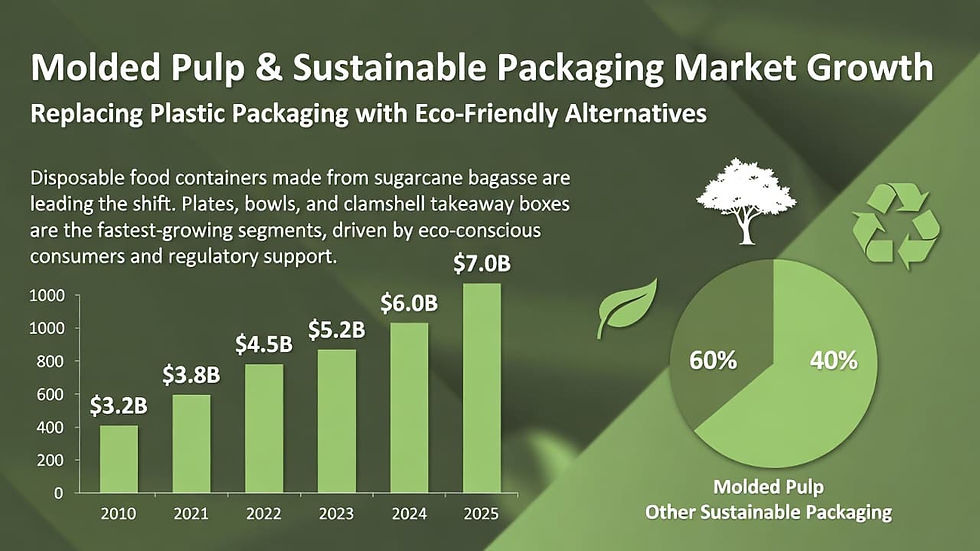
Looking ahead, it is likely that plastic will remain an important material in food packaging.
However, the industry may gradually move toward a more diversified material landscape.
Several trends are likely to shape the market over the next five years:
Continued development of molded fiber manufacturing technologies
Increasing regulatory pressure on certain single-use plastics
Greater emphasis on supply chain resilience
As these factors evolve, packaging buyers may increasingly evaluate materials not only based on unit cost but also on long-term stability and regulatory compatibility.
Conclusion
The disposable packaging industry is changing slowly but surely.
Plastic materials like polypropylene and PET will still be important for many uses. But energy market ups and downs, supply chain problems, and new rules are pushing companies to rethink how they buy packaging materials.
Many buyers are no longer using just one material. They are starting to spread out their sourcing choices. Fiber-based materials like sugarcane bagasse are becoming part of this wider mix of options.
For companies in the foodservice and packaging fields, it will be important to understand these changing material trends.
FAQ
Why are packaging buyers reducing their reliance on plastic?
Plastic prices can fluctuate due to oil markets and supply chain disruptions. Companies are exploring alternative materials to improve cost stability and meet sustainability goals.
What materials are commonly used as alternatives to plastic packaging?
Common alternatives include sugarcane bagasse, molded pulp, bamboo fiber, and paper-based packaging materials.
Is bagasse packaging suitable for foodservice applications?
Yes. Bagasse can be molded into various food packaging products such as plates, bowls, trays, and takeaway containers.
Will plastic disappear from the packaging industry?
Plastic will likely remain widely used in many applications. However, alternative materials are expected to play a growing role in the disposable packaging market.

Email: abel@mana-eco.com
WhatsApp: +86 13867471335
We specialize in a full range of disposable tableware. With fully automated production lines and certifications like FDA, BPI, and OK Compost, we offer high-quality, eco-friendly tableware made from biodegradable materials such as sugarcane bagasse and PLA, committed to providing customers with more sustainable and environmentally friendly options.


Comments