
OEM, ODM, and OBM in the Disposable Tableware Industry: A Practical Guide for the U.S. Market


The disposable tableware industry is often described as “manufacturing-driven.”But in reality, the business model behind manufacturing—OEM, ODM, or OBM—defines who controls pricing, margins, and long-term growth.
For U.S. importers, foodservice brands, distributors, and private-label sellers, understanding these three models is essential when sourcing disposable plates, cups, cutlery, and compostable food packaging.
This article explains OEM, ODM, and OBM specifically within the disposable tableware industry, with real manufacturing logic, cost implications, and strategic insights for the U.S. market.
What Is OEM in the Disposable Tableware Industry?

OEM Definition (Original Equipment Manufacturer)
OEM refers to a manufacturing model where the factory produces disposable tableware strictly according to the buyer’s specifications, while the buyer owns:
Product design
Brand name
Packaging artwork
Sales channels
The manufacturer focuses on production efficiency, quality control, and cost management.
In the U.S. disposable tableware market, OEM is the most common sourcing model, especially for:
Compostable products (PLA, CPLA)
How OEM Works in Practice
Typical OEM workflow:
OEM Advantages and Limitations
Aspect | OEM Strengths | OEM Limitations |
Cost | Lower unit cost at scale | Thin margins |
Risk | Low market risk for factory | High price competition |
Flexibility | Easy to switch suppliers | Low differentiation |
Brand value | Buyer-controlled | Factory builds no brand |
Industry reality:Most disposable tableware OEM factories operate on 5–15% gross margins, highly sensitive to resin or pulp price fluctuations.
What Is ODM in Disposable Tableware Manufacturing?
ODM Definition (Original Design Manufacturer)
ODM goes one step beyond OEM.
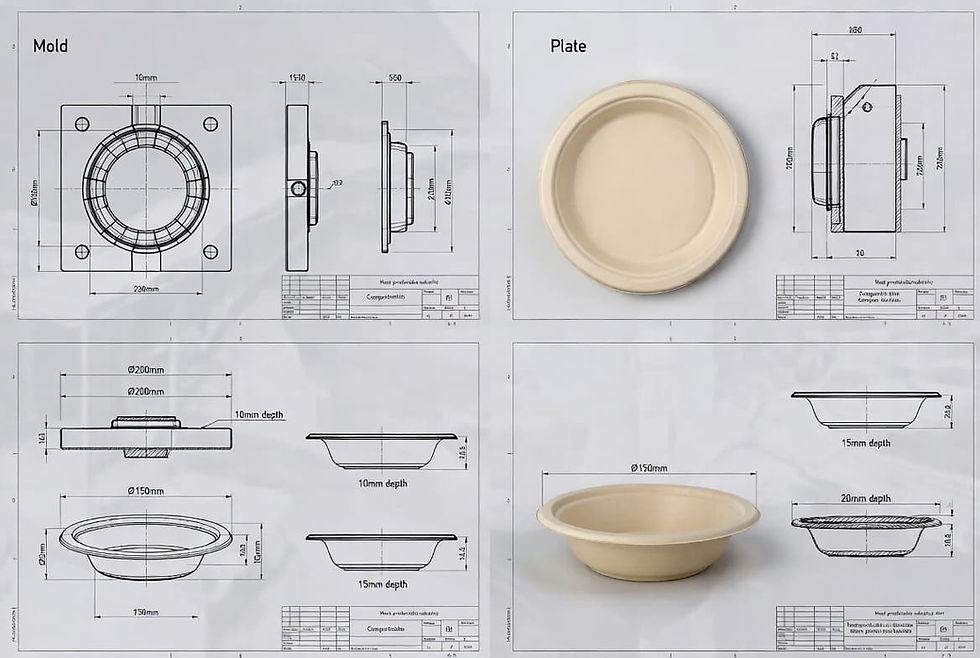
An ODM manufacturer designs the product first, then allows buyers to brand it as their own.
In disposable tableware, ODM usually means the factory owns:
Product structure design
Mold development
Functional testing data
Existing SKUs ready for mass production
Buyers customize branding and packaging but do not start from zero.
Why ODM Is Growing in the U.S. Market
ODM is increasingly popular among:
Amazon FBA sellers
Foodservice distributors
Emerging eco-friendly brands
Key reasons:
Faster time to market
Lower development cost
Proven manufacturing feasibility
Reduced MOQ compared to full OEM customization
OEM vs ODM: Core Differences
Category | OEM | ODM |
Product design | Buyer-owned | Manufacturer-owned |
Mold cost | Buyer pays | Usually absorbed or shared |
Speed to market | Slower | Faster |
Differentiation | Limited | Moderate |
Original insight:In compostable tableware, ODM often provides better real-world performance because designs have already been tested for heat resistance, oil resistance, and structural strength—issues many first-time buyers underestimate.
What Is OBM in the Disposable Tableware Industry?
OBM Definition (Original Brand Manufacturer)
OBM refers to manufacturers that own and operate their own brand, controlling:
Product design
Branding and positioning
Sales channels and customer relationships
In the U.S. market, OBM companies sell not just products—but solutions.
How OBM Creates Value Beyond Manufacturing
OBM disposable tableware brands typically compete on:
Sustainability positioning
Regulatory compliance expertise
Supply chain stability
Consistent quality standards
They are often preferred by:
National foodservice chains
Institutional buyers
Long-term distribution partners
OEM vs ODM vs OBM: Strategic Comparison
Dimension | OEM | ODM | OBM |
Price control | Buyer | Buyer | Brand |
Gross margin | Low | Medium | High |
Customer loyalty | Low | Medium | High |
Market power | Weak | Moderate | Strong |
Long-term value | Limited | Transitional | Sustainable |

The Typical Upgrade Path in the Disposable Tableware Industry
Most successful manufacturers do not jump directly to OBM.
A realistic evolution path:
OEM → ODM → Hybrid OBM
Why a Hybrid Model Works Best
Many advanced manufacturers:
Maintain OEM volume for cash flow
Develop ODM product lines for differentiation
Operate OBM brands in selected markets
This structure balances risk, margin, and long-term brand equity.
OEM, ODM, and OBM in Compostable & Sustainable Tableware
Industry-Specific Insight (Original Content)
In compostable disposable tableware, the business model matters more than material choice.
Key factors often overlooked:
Certification maintenance cost (BPI, OK Compost)
Mold lifespan for bagasse products
Performance trade-offs between PLA and fiber
Regional composting infrastructure in the U.S.
ODM and OBM manufacturers are typically better positioned to handle these complexities, while pure OEM suppliers may only meet minimum compliance, not long-term consistency.
FAQ
Is OEM cheaper than ODM or OBM?
Yes, at unit level. But OEM often results in higher hidden costs due to redesigns, quality disputes, and supplier switching.
Can a manufacturer be OEM and OBM at the same time?
Yes. Many large disposable tableware manufacturers operate multi-model structures.
Which model is best for entering the U.S. market?
Startups: ODM
Importers & distributors: OEM or ODM
Long-term brands: OBM or hybrid
Does ODM limit brand differentiation?
Only partially. Differentiation can still be achieved through packaging, bundling, compliance positioning, and supply reliability.
Final Thoughts for the U.S. Disposable Tableware Market
OEM, ODM, and OBM are not just manufacturing terms—they represent three completely different business strategies.
For companies sourcing disposable tableware in the U.S., understanding these models helps:
Control cost more effectively
Reduce supply chain risk
Build long-term brand value
For manufacturers like Mana Packaging, combining manufacturing strength with design capability and compliance expertise creates a competitive edge that goes far beyond price.

Email: abel@mana-eco.com
WhatsApp: +86 13867471335
We specialize in a full range of disposable tableware. With fully automated production lines and certifications like FDA, BPI, and OK Compost, we offer high-quality, eco-friendly tableware made from biodegradable materials such as sugarcane bagasse and PLA, committed to providing customers with more sustainable and environmentally friendly options.


Comments